
Domestic Violence
About 41% of women and 26% of men experienced contact sexual violence, physical violence or stalking by an intimate partner during their lifetime and reported a related impact. 1
Domestic violence refers to a pattern of behaviors used by an individual to maintain power and control over another member of a household, including, but not limited to, intimate partners and children. Domestic violence can take the form of physical or sexual violence, threats, psychological abuse, domestic abuse or financial control. Everyone deserves to live in safe and healthy households and loving relationships free of abusive behavior.
About Domestic Violence
Domestic violence is a pattern of abusive behavior by an intimate partner (spouse, dating partner, ex-partner) that includes several forms of violence. Domestic violence can vary in how often it happens and how severe it is. It can range from one episode of violence to chronic and severe episodes over multiple years. Read an overview on these tactics.
Domestic Violence Statistics
Domestic violence is unfortunately very common and widespread. Millions of people are impacted, and the percentages of intimate partners facing severe violence and death are alarming.
Know the Warning Signs
Signs of domestic violence can be difficult to recognize because of its diverse forms. View a list to help identify abuse.
Healthy Relationships
Everyone deserves a healthy relationship. See what healthy relationships look like compared to dangerous or unhealthy relationships.
Effects of Trauma Caused by Domestic Violence
Each domestic violence survivor responds differently to abuse. They can also face similar effects in its aftermath.
About Domestic Violence
Everyone deserves to be in a healthy and loving relationship free of abusive behavior. Domestic violence (also called intimate partner violence or IPV) is a pattern of behaviors used by a current or former partner to maintain power and control over another partner in an intimate relationship. IPV can happen through physical violence, sexual violence, threats, psychological or emotional abuse or financial control.
The behavior can be subtle, with abusers using a variety of ways to gain control, including insulting their partners, controlling their contact with family members and friends or limiting how their partners can spend money. Abuse can escalate and become more frequent with consistent physical injuries, such as hitting or slapping, sexual assaults or threats to victims’ safety. However, even if it does not become explicitly physical, it may still be intimate partner violence.
What are some types of domestic violence?
There isn’t a single definition of domestic violence. It can take on several forms, with a range of behaviors. There are several common forms of abuse associated with domestic violence:
- Physical abuse. This includes pain, injury and bodily harm, such as beating, kicking, suffocation or slapping.
- Sexual abuse. This includes sexual harassment, sexual assault or manipulating a person into having sex through guilt or threats.
- Emotional and/or verbal abuse. This includes constant criticism, threatening to hurt loved ones or harassment at school or in the workplace.
- Economic abuse. This includes controlling a person’s income or financial assistance, misusing a person’s credit or making it difficult for a person to get or maintain a job.
- Psychological abuse. This includes minimizing or blaming a person for the abuse, intimidation, destroying property and/or threats .
- Digital and image-based abuse. This includes controlling passwords and social media accounts, posting non-consensual images, searching phone and text messages and monitoring with a GPS or related system.
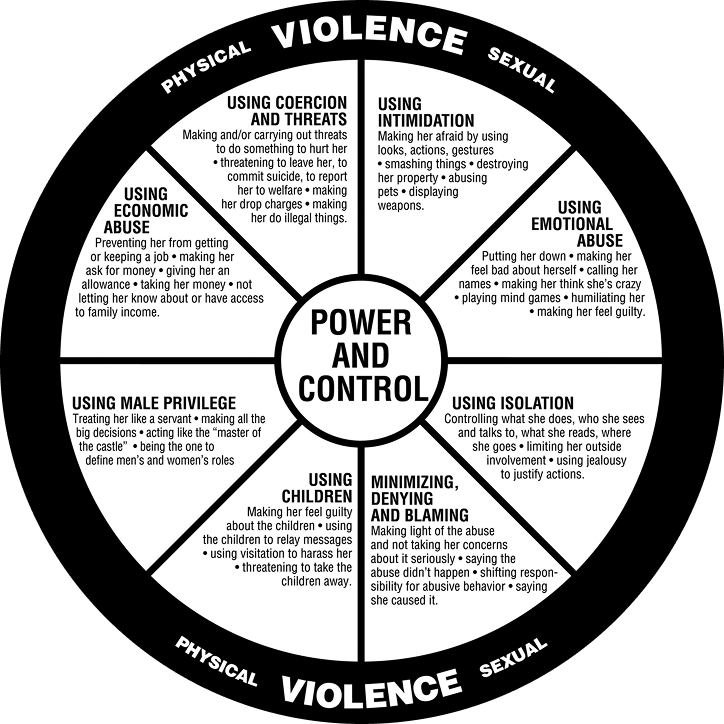
The Power and Control Wheel, developed by the Duluth Model, is a tool that illustrates common tactics used by abusers. It is widely used in domestic violence education and intervention programs to help victims recognize abuse and seek support.
Why Do People Commit Abuse?
Domestic violence and other types of abusive relationships are based on power and control. If one current or former partner feels the need to dominate the other in any shape or form, it is significantly more likely a relationship will turn violent. The Power and Control Wheel, originally developed by the Domestic Abuse Intervention Project in Duluth, Minnesota, shows abusive and violent patterns of behavior that perpetrators use to gain and maintain power and control.
Effects of Domestic Violence
Domestic violence survivors can face ongoing and challenging effects after enduring physical, mental, sexual, financial and emotional abuse. While addressing this pain can be overwhelming, the healing process can empower survivors. On this journey, it is important for survivors and those who support them to understand that healing takes time. The effects of this trauma can vary widely from person to person due to individuals’ responses to the frequency and severity of abuse.
What are common mental effects of domestic violence?
- Post-traumatic stress disorder (PTSD), including flashbacks, nightmares, severe anxiety and uncontrollable thoughts
- Depression, including prolonged sadness
- Anxiety
- Low self-esteem and questioning sense of self
- Self harm, suicidal thoughts or attempts at suicide. If you or someone you know is feeling suicidal, contact the National Suicide Prevention Lifeline at 1.800.273.8255.
- Alcohol and drug abuse
What are common effects on children who witness domestic violence?
Whether children witness or experience abuse, it can take a toll on their development. It is important to note that victims of domestic violence are not limited to intimate partners. Children are at an increased risk for emotional and behavioral problems regardless of whether they were directly abused or not.
Domestic Violence Statistics
Domestic violence spans gender, age, sexual orientation and religion, and it affects people of all socioeconomic backgrounds and education levels. Abuse can escalate and take on many forms, and includes risks of severe violence and death. As survivors attempt to move on after experiencing abuse, they can face immense negative effects regarding their sense of personal safety.
Domestic violence is widespread and severe for both women and men in the U.S. This abuse includes physical acts of violence, such as battery with a fist or something hard, kicking, hair pulling, slamming an individual against something, choking, suffocation, beating, burning and/or use of a knife or firearm.
1 in 4
Women
in the U.S. have experienced sexual violence, physical violence and/or stalking by an intimate partner in their lifetime. 2
1 in 10
Men
in the U.S. have experienced sexual violence, physical violence, and/or stalking by an intimate partner during their lifetime. 2
10%
Of women
and 2.2% of men report having been stalked by an intimate partner. 3
Data from US crime reports suggest that 16% of homicide victims (about 1 in 6 individuals) are killed by an intimate partner. Nearly half of female homicide victims in the US are killed by a current or former male intimate partner. 3
Know the Warning Signs
There are signs for family and friends that can help them identify whether someone they know is involved in a harmful relationship.
What are common signs your partner is behaving abusively in a relationship?
- Keeps you from seeing or contacting your family and friends
- Takes and controls money, including refusing to give you money or controlling how it’s spent
- Insults, shames you or puts you down
- Controls all aspects of your life, including what you do, what you wear, and where you go
- Has unrealistic expectations, such as expecting you to be available at all times
- Threatens to take away or hurt your children
- Threatens to hurt or kill pets
- Denies abuse is happening or downplays it as a problem
- Plays mind games and places blame
- Destroys property
- Forces you to use drugs or alcohol
- Intimidates you with guns, knives or other weapons
- Shoves, slaps, chokes and/or hits you
- Forces sexual acts on you against your will
- Threatens to commit suicide
What are some common signs of each type of abuse?
Any of these signs should alarm you that a relationship is abusive. A perpetrator does not need to use all of these actions to be an abuser— even one of these behaviors is a sign of domestic violence.
Everyone Deserves a Healthy Relationship
10 Signs of a Healthy Relationship
Every healthy relationship should include these characteristics and behaviors.
Comfortable Pace
Relationships should happen at a pace that is comfortable for both people in the relationship. No one should feel pressured to move forward before they are ready.
Trust
You should be sure your partner won’t do anything to hurt you or ruin the relationship. Your partner shouldn’t limit what you do because they believe you will hurt them.
Honesty
You and your partner should be able to talk to each other without worrying what the response will be. A healthy partner will not judge you and will be considerate of your feelings when communicating with you.
Independence
It’s important to have space and freedom in your relationship. You should both be able to do things on your own.
Respect
Your partner should support you and value your beliefs, opinions and who you are.
Equality
You should both have the same say in making decisions and coming to agreements together.
Compassion
There should be a shared sense of care and concern in a healthy relationship.
Taking Responsibility
Partners in a healthy relationship will avoid putting blame on each other and apologize when one of you makes a mistake.
Loyalty
You should feel sure that your partner will stick up for you and be respectful and faithful.
Communication
You should be able to talk to your partner about anything, whether good or bad.
10 Signs of an Unhealthy Relationship
Unhealthy relationships may begin with subtle behaviors, but can escalate to violence.
Intensity
This includes overwhelming behaviors and feelings. You may feel like the relationship is moving too fast, you partner may want to always be with you, or you may feel like your partner is obsessed with you.
Jealousy
A partner lashes out or controls you when they are jealous. If you can’t spend time with other friends, are accused of cheating or your partner begins to follow you everywhere, this is a sign of an unhealthy relationship.
Manipulation
You may be manipulated if your partner tries to influence your decisions and actions, including convincing you to do things you don’t want to do or giving you gifts and apologizing to influence how you feel and act.
Isolation
If your partner doesn’t allow you to talk to or spend time with others like friends and family, your partner may be trying to isolate you.
Sabotage
Your partner may try to ruin your reputation or achievements. This includes starting rumors or making you miss school activities.
Belittling
In an unhealthy relationship, partners may call you names, be rude or make fun of you.
Guilting
You may be made to feel guilty for your partner’s actions, including being treated like everything is your fault, or your partner threatening to hurt themselves if you don’t do what they want.
Volatility
If you are constantly nervous you may do something to make your partner angry or you can’t predict when they will lash out, this is a sign of an unhealthy relationship.
Deflecting Responsibility
Your partner may make excuses for their behavior like blaming you or excusing the behavior because they used alcohol or drugs.
Betrayal
Your partner may lie to you, leave you out of situations, act differently when friends are around or cheat on you.
Emergency Resources
There are resources available for you. You are not alone. In an emergency, call 911.
- Leemis RW, Friar N, Khatiwada S, Chen MS, Kresnow M, Smith SG, Caslin S, & Basile KC. (2022). The National Intimate Partner and Sexual Violence Survey: 2016/2017 Report on Intimate Partner Violence. Atlanta, GA: National Center for Injury Prevention and Control, Centers for Disease Control and Prevention.
- Smith, S.G., Zhang, X., Basile, K.C., Merrick, M.T., Wang, J., Kresnow, M., Chen, J. (2018). The National Intimate Partner and Sexual Violence Survey (NISVS): 2015 Data Brief – Updated Release. Atlanta, GA: National Center for Injury Prevention and Control, Centers for Disease Control and Prevention.
- Cooper, A., & Smith, E. L. (2011). Homicide trends in the United States, 1980–2008. Washington, D.C.: Bureau of Justice Statistics. NCJ 236018. 6. Petrosky, E., Blair, J. M., Betz, C. J., Fowler, K. A., Jack, S., & Lyons, B. H. (2017). Racial and Ethnic Differences in Homicides of Adult Women and the Role of Intimate Partner Violence – United States, 2003-2014. MMWR. Morbidity and mortality weekly rep